
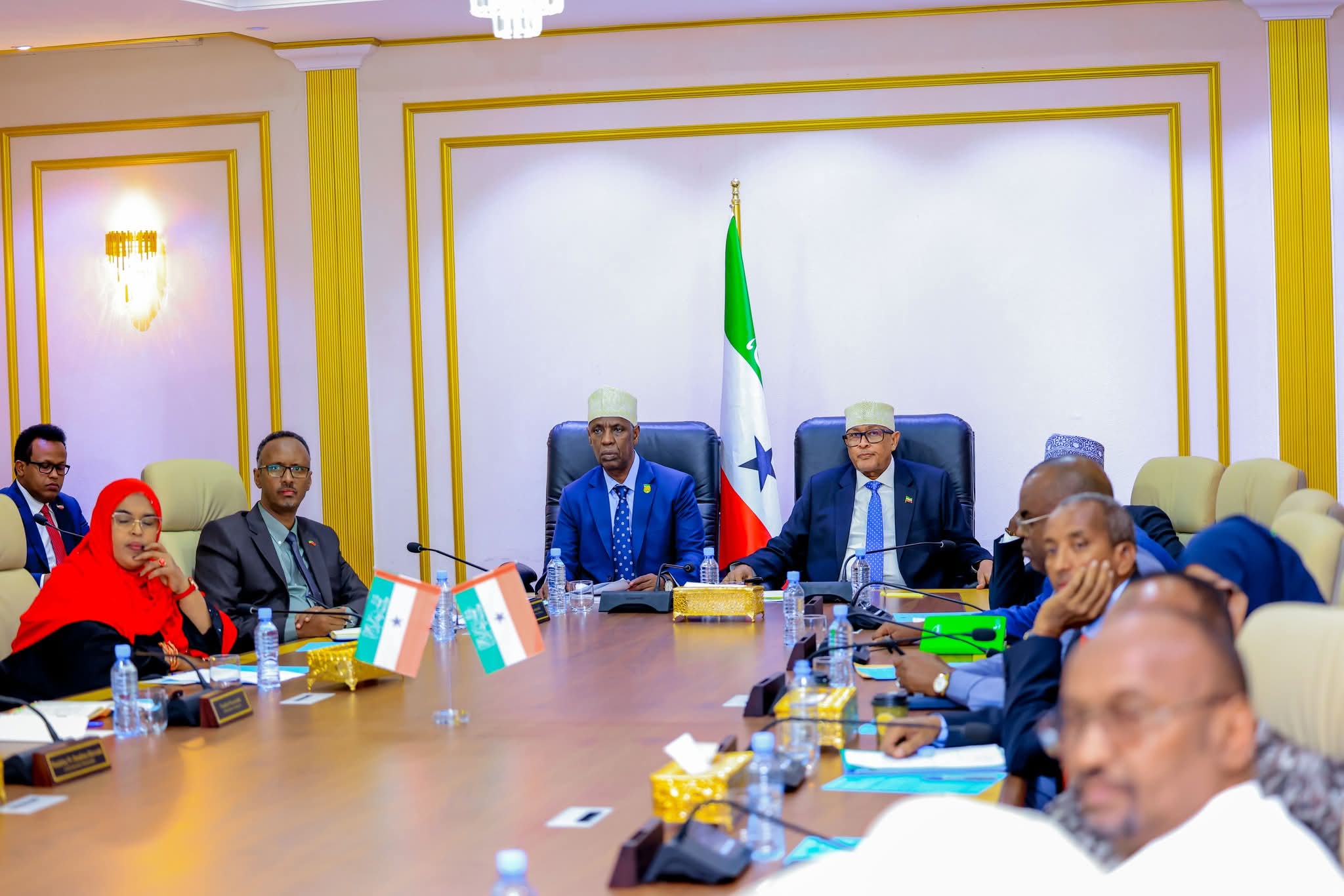
The Council of Ministers of the Republic of Somaliland, under the leadership of President H.E. Abdirahman Mohamed Abdillahi (Irro), held an extraordinary session today to address what it described as “escalating and provocative interference” by the Federal Government of Somalia, particularly in the eastern Sool region.
In a strongly worded communiqué released after the meeting, the Cabinet reaffirmed Somaliland’s sovereignty, territorial integrity, and commitment to peace while condemning Somalia’s recent actions as violations of international norms.
Reaffirming Sovereignty
The government reiterated that Somaliland is a sovereign, self-governing state, with borders inherited from its independence from the United Kingdom on June 26, 1960. The communiqué stated that the failed union with Somalia, which collapsed in 1991, no longer holds any legitimacy.
“Somaliland’s sovereignty is not speculative—it is a political, legal, and functional reality,” the statement read. “It is final, legitimate, and irreversible.”
Condemning Destabilizing Actions
The Cabinet accused the Federal Government of Somalia of unlawful interference through “incendiary rhetoric, political subversion, and diversion of international resources” meant for peacebuilding. It said these actions are driven by political desperation ahead of Somalia’s upcoming elections.
“These maneuvers threaten to unravel regional stability with consequences far beyond our borders,” the communiqué stated, condemning the alleged misuse of aid and arms to destabilize Somaliland.
Territorial Integrity Declared Non-Negotiable
Somaliland declared that the regions of Sool, Sanaag, and Togdheer are an inseparable part of its sovereign territory. The government criticized Mogadishu’s portrayal of these areas as disputed and accused it of exploiting clan divisions for political gain.
“The Republic of Somaliland unequivocally rejects any efforts to impose parallel governance structures or alter its borders under the guise of federalism,” the statement read.
Commitment to Peaceful Dialogue
Despite the rising tensions, the government emphasized its continued dedication to peaceful engagement. It highlighted recent reconciliation successes in the Sanaag region as proof of its commitment to dialogue and inclusivity.
“Somaliland champions peace but will not compromise on its internal stability or constitutional order,” the Cabinet declared.
Call for International Accountability
The communiqué also urged the United Nations Security Council, donors, and regional bodies to closely monitor the arms embargo situation in Somalia. It warned that weapons intended for counterterrorism are allegedly being diverted to destabilize Somaliland and neighboring areas.
“The diversion of arms to extremist groups poses a grave threat to peace in the Horn of Africa,” the government said, calling for robust international oversight and transparency.
Defending Somaliland’s Sovereignty
The Cabinet concluded by reaffirming Somaliland’s right and readiness to defend its sovereignty by all lawful means, including diplomacy, politics, and, if necessary, defensive measures.
“Any attempt to undermine Somaliland’s sovereignty will be met with firm, lawful resistance,” the communiqué stated. “Our sovereignty, security, and territorial integrity are sacrosanct and non-negotiable.”
The government reiterated its openness to dialogue with genuine partners committed to peace and mutual respect, but firmly rejected any interference in its internal affairs.
more recommended stories
 My Country, Somaliland, Recognized
Our first embassy will be in.
 The Arithmetic of Erasure: Deconstructing Mogadishu’s Narrative
By Abdiwahab Sancawl When the UN.
 Somaliland Recognition: A Litmus Test for Israel’s Post Gaza Global influence
Israel’s recognition of Somaliland, a long.
-
Awdal’s Strategic Role in Somaliland’s Statehood and National Stability
The people of Awdal, particularly those.