
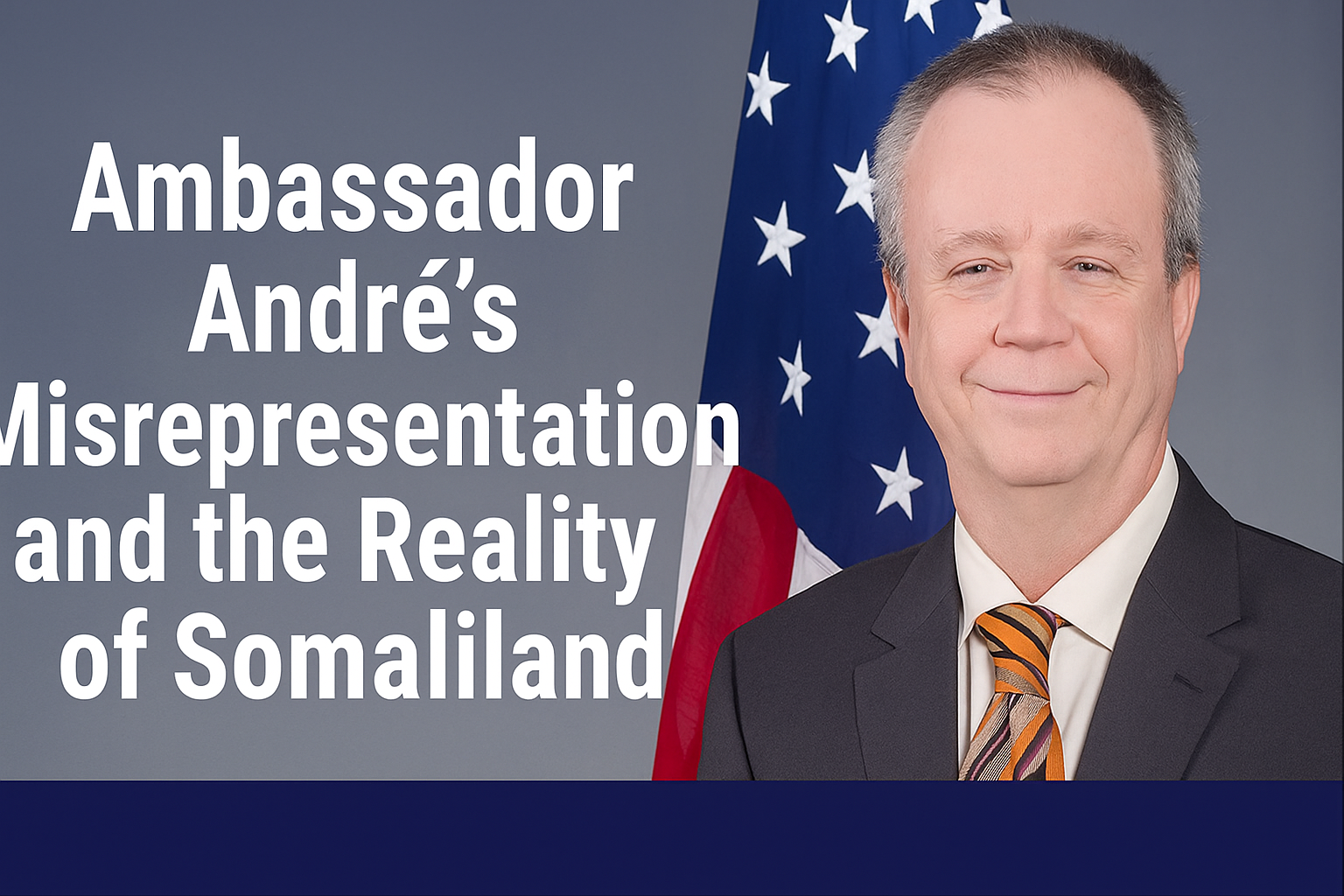
In a recent article, Ambassador (ret.) Larry André urged caution and delay on the question of Somaliland’s recognition. His arguments, dressed in the language of prudence, recycle decades-old talking points that obscure history, distort realities, and ultimately justify continued paralysis. After thirty-four years of self-rule, Somaliland does not need more deferrals or symbolic offices—it needs recognition. To continue denying it is to punish peace and reward failure.
The Ambassador begins with the familiar claim that all United Nations members recognize Somalia within its 1960 borders, and therefore Somaliland’s independence is illegitimate. This framing is both historically inaccurate and legally flawed.
The reality is that Somaliland was an independent, internationally recognized state for five days in June 1960. It entered into a voluntary union with Somalia, only to see that union collapse in blood and betrayal by 1991. Somaliland did not secede—it restored its sovereignty after the contract of union was broken. International law distinguishes between secession and restoration, and that distinction makes Somaliland’s case fundamentally different from contemporary separatist movements. Erasing this history is not analysis; it is revisionism.
André also tries to reduce Somaliland’s struggle to the ambitions of one clan, the Isaaq. This is both unfair and inaccurate. Somaliland’s reconstruction in the 1990s was built on inclusive peace conferences where non-Isaaq communities—Gadabuursi, Harti, and others—played significant roles. Minority groups continue to be represented in parliament, cabinet, and civil society. This inclusiveness is one of the reasons Somaliland succeeded where Somalia collapsed. While Somalia imported federalism under external pressure decades later, Somaliland built reconciliation and governance from the ground up. To dismiss Somaliland as an “Isaaq-only project” erases this history of inclusivity and denies the lived reality of a functioning multi-clan society.
Equally troubling are the Ambassador’s allegations that Somaliland suppresses dissent, bans alternative political expression, and imprisons those who advocate reunion with Somalia. These are serious charges, yet he provides no evidence. Which independent reports confirm systemic repression? Where are the documented cases? None are cited.
Without proof, such claims are little more than recycled rumor. Like every young democracy, Somaliland faces challenges, but it has also organized competitive multiparty elections, overseen peaceful transfers of power, and maintained working state institutions in one of the world’s harshest environments. To dismiss these achievements while elevating unverified accusations is not balance—it is distortion.
On security, Ambassador André’s suggestion that Somaliland’s stability exists only because international forces contain al-Shabaab in the south is not just inaccurate—it is a distortion that trivializes Somaliland’s achievement. Mogadishu depends for its very survival on tens of thousands of African Union troops, massive donor funds, and U.S. airstrikes. Without this scaffolding, the Somali government would collapse almost overnight.
Somaliland, by contrast, has safeguarded its territory without a single foreign soldier, without international air cover, and without the billions in aid that Mogadishu consumes. Its peace was built from the ground up: through painstaking reconciliation among communities, locally financed security forces, and a degree of legitimacy that no externally propped-up authority can replicate. This is a rare and remarkable achievement in the Horn of Africa.
For Ambassador André to dismiss this as a side effect of Somalia’s war in the south is to deny three decades of hard-earned success. Somaliland has accomplished what many outsiders thought impossible: genuine stability without occupation, dependency, or imported blueprints. Such claims are not serious analysis; they are outdated talking points that collapse under scrutiny.
The Ambassador’s invocation of Eritrea and South Sudan as precedents for recognition also misses the point. He argues that recognition followed agreements with their parent states, implying Somaliland must first negotiate with Mogadishu. But both Eritrea and South Sudan achieved recognition only after devastating wars. Somaliland chose peace in 1991. If recognition depends on Mogadishu’s consent—a government that has failed for thirty-four years to build consensus—the message is disastrous: violence is rewarded, peace is punished. It would encourage armed struggle elsewhere rather than dialogue.
Somaliland’s peaceful path should be recognized as a model, not dismissed as insufficient.
Equally flawed is the Ambassador’s insistence on endless consultations with Mogadishu, Djibouti, Ethiopia, and the African Union before any recognition.
These regional actors have strategic interests in preserving the fiction of Somali unity, even as the ground reality proves otherwise. Djibouti and Ethiopia use the Somali question for leverage in regional politics; Mogadishu clings to claims of territorial integrity it cannot enforce; and the African Union remains paralyzed by its outdated doctrine of “respecting colonial borders,” even when those borders have long since failed. Somaliland’s sovereignty is not theirs to veto. The right to self-determination belongs to the people of Somaliland, not to governments seeking geopolitical convenience.
André’s so-called “middle option”—opening a U.S. diplomatic office in Hargeisa while withholding recognition—is little more than window dressing. Somalilanders have governed themselves competently for over three decades. They do not need another liaison office or another round of hollow dialogue. They need acknowledgment of the state they have already built. Diplomatic delay does not promote stability—it perpetuates frustration, undermines democratic achievements, and signals that the international system rewards dependency and dysfunction rather than responsibility and self-reliance.
The deeper flaw in the Ambassador’s reasoning is that it treats Somaliland as a bargaining chip in regional politics rather than as a political community with rights of its own. It ignores that Somaliland has functioned as a state for longer than South Sudan has existed, longer than Eritrea has enjoyed independence, and longer than most federal units of Somalia have even held together. Somalilanders have paid for their peace with sacrifice and persistence. They have held elections, maintained security, and built institutions without aid packages or foreign armies. Meanwhile, Somalia has consumed billions in donor assistance and still struggles to secure its capital.
Somaliland’s case is not just about recognition—it is about fairness, justice, and consistency. The principle of self-determination has been applied selectively, often rewarding violence and penalizing restraint. Kosovo was recognized despite fierce Serbian opposition. South Sudan was welcomed after decades of war. Eritrea was acknowledged after a military victory. Somaliland chose negotiation, reconciliation, and institution-building. Denying recognition now enshrines a dangerous lesson: violence is rewarded, peace is punished.
Ambassador André’s caution is not prudence; it is paralysis. It prolongs a limbo that serves no one. Somaliland exists. It governs. It secures. It aspires to participate as a responsible member of the international community. Recognition is not a gift but a correction of history. It would stabilize the Horn by anchoring a democratic and reliable partner in a region where authoritarianism and extremism thrive. It would demonstrate that the international system rewards those who choose peace, not those who perpetuate chaos.
After thirty-four years of effective sovereignty, Somaliland’s claim is not speculative—it is proven. Ambassador André’s arguments rest on myths of clan exclusivity, unfounded allegations, and an outdated fixation on borders that no longer function. The facts speak for themselves: Somaliland is here, it is stable, and it is ready. The only question is whether the world has the courage to acknowledge what already exists.
Recognition is not only just—it is wise. To deny it any longer is to punish success and reward failure. The time for hesitation has passed. The United States and its allies must move beyond symbolic gestures and grant full recognition to the Republic of Somaliland.
more recommended stories
 My Country, Somaliland, Recognized
Our first embassy will be in.
 The Arithmetic of Erasure: Deconstructing Mogadishu’s Narrative
By Abdiwahab Sancawl When the UN.
 Somaliland Recognition: A Litmus Test for Israel’s Post Gaza Global influence
Israel’s recognition of Somaliland, a long.
-
Awdal’s Strategic Role in Somaliland’s Statehood and National Stability
The people of Awdal, particularly those.