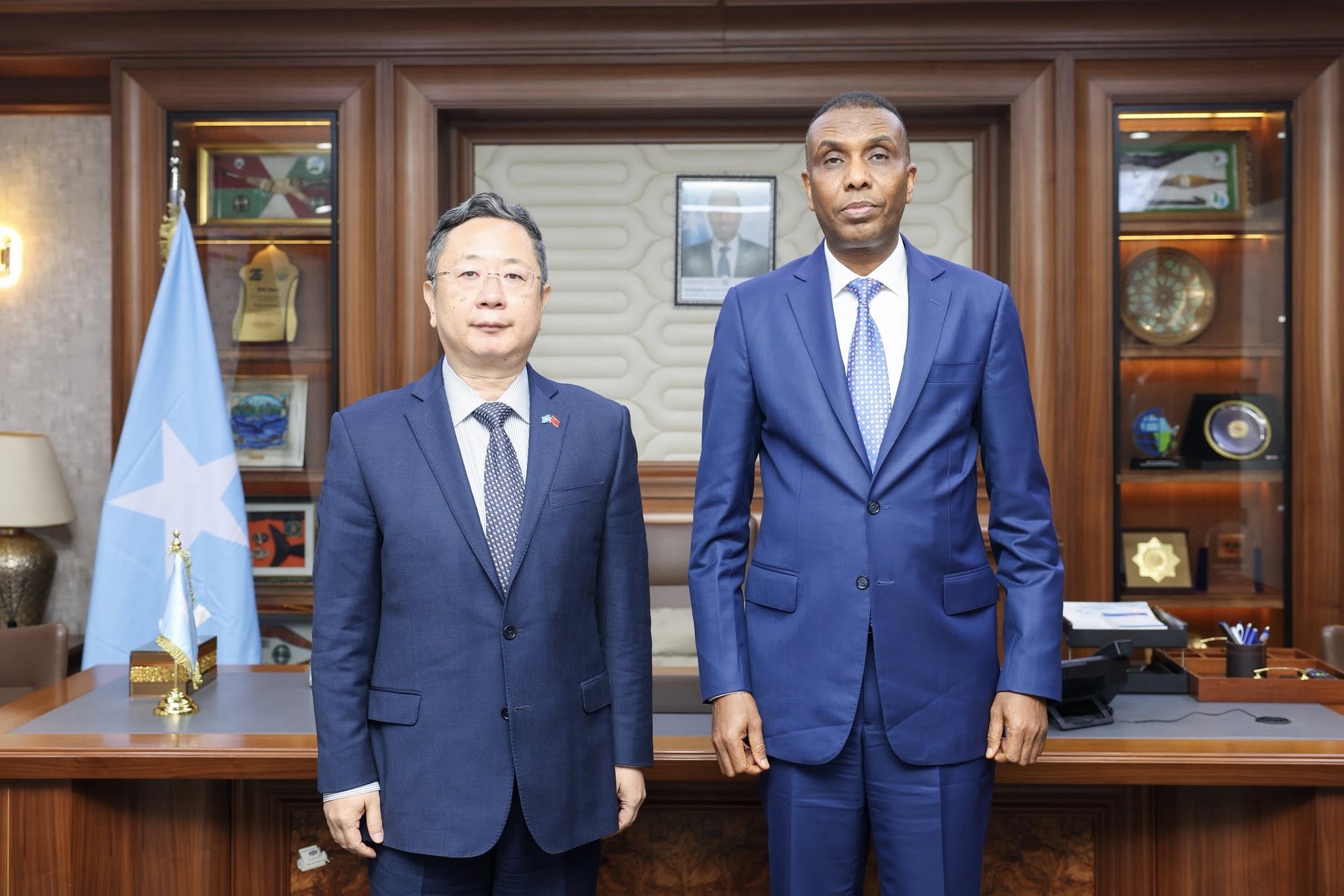
@AmbWangYu
visited H.E. PM
@HamzaAbdiBarre
in
@SomaliPM
.

Editorials reflect the institutional voice of Somaliland.com. This piece examines Mogadishu’s reckless campaign against Somaliland at a time when global recognition is entering mainstream debate.
The failed leadership in Mogadishu, from President Hassan Sheikh to his unqualified ministers, has made Somaliland their central obsession. Instead of governing Somalia, securing the capital, or delivering basic services, the administration expends its energy on schemes to destabilize Somaliland.
Defense Minister Ahmed Fiqi’s incendiary rhetoric and Prime Minister Hamse Barre’s full-throated support for the Eastern Las’anod militia, coupled with his calls to destabilize Awdal, expose a government that views Somaliland’s peace and democracy not as a model to emulate, but as a threat to extinguish. This campaign is waged through propaganda, the arming of militias, and reckless incitement.
The Sool region has been transformed into a proxy battlefield where Mogadishu and its foreign allies have armed local militias, created chaos, encouraged bloodshed, and urged Somalilanders who have chosen peace to turn against their own state. Left unchecked, such destabilization risks turning the area into a safe haven for terrorist groups. And now, having fueled destruction in the east, Hassan Sheikh and his partners have shifted their focus to Awdal in Somaliland’s west. A government unable to secure its own capital has no moral or political authority to summon others into chaos.
The case of Sultan Wabar illustrates the cynicism of this strategy. A discredited figure from Awdal, Wabar has been elevated by Mogadishu as a tool for disruption in the Awdal region. The Hassan Sheikh administration arranged meetings for him with foreign embassies, including Turkey and China, to plan destabilization in Somaliland’s west. These maneuvers are not diplomacy but desperation exporting conflict to conceal Mogadishu’s own failures.
China’s involvement highlights the extent of this agenda. Angered by Somaliland’s growing partnership with Taiwan, Beijing has aligned itself with Mogadishu’s schemes. In Las’anod, China’s hand is evident in its backing of clan conferences designed to keep pliant figures in power. In Mogadishu, Wabar has quietly met Chinese officials behind closed doors, securing support while avoiding media scrutiny. The goal is transparent: punish Somaliland for its Taiwan ties, deny its stability, and keep it trapped in instability.
Yet China is only part of the picture. The real driver is Mogadishu itself. Hassan Sheikh’s administration cannot accept the reality of a functioning, democratic Somaliland because it exposes their own incompetence. Rather than confront their citizens’ demand for security, services, and accountability, they look outward, plotting against a neighbor that has succeeded
where they have failed. By inviting foreign powers into these schemes, they reveal weakness, not strength.
This period has exposed the depth of their panic. With Somaliland’s recognition openly discussed at the highest levels including by U.S. President Donald Trump Mogadishu sees what lies directly ahead: Somaliland stepping into its rightful place among peace-loving, democratic societies. Their response has been predictable: sabotage, propaganda, and proxy wars. But the age of Mogadishu’s veto is over. No one asks them about Somaliland anymore.
The world increasingly acknowledges that Somaliland is not a bargaining chip for failed leaders. It is a functioning state, moving forward with dignity and resolve, whether Mogadishu approves or not.
One recent and heavyweight voice that has become a nightmare for President Hassan Sheikh and his alliances and has accelerated their ill-fated campaign against Somaliland is that of U.S. Senator Ted Cruz, a highly respected senior Republican lawmaker and influential figure in American politics. Senator Cruz publicly urged President Trump to formally recognize Somaliland as an independent state. This intervention, coming from one of Washington’s most powerful voices, has shaken Mogadishu’s leadership to its core. It underscored the reality that Somaliland’s recognition is no longer a distant dream, but a matter actively debated at the highest levels of U.S. policy.
Meanwhile, Somalia’s own crises remain untouched. Al-Shabaab still threatens the outskirts of Mogadishu, corruption corrodes public institutions, and millions of citizens live without security or opportunity. Instead of addressing these failures, Hassan Sheikh and his ministers plot against Somaliland, distracting their people with manufactured threats. They incite unrest in Awdal while failing to provide even basic safety in the capital.
Somaliland does not need lectures or interference from Mogadishu. Its people have chosen peace, unity, and democracy. That choice cannot be undone by arming militias, inventing fake sultans, or enlisting foreign embassies. Mogadishu’s panic has nothing to do with Somaliland’s legitimacy; it reflects only its own collapse.
Somaliland’s stability proves that Somalis can govern themselves with discipline and vision. That example terrifies Mogadishu’s elites, for it highlights what they have failed to build. But no matter how many proxy wars they wage or embassies they conspire with, Somaliland’s peace and democracy are not theirs to undo.
For Somaliland, the path is irreversible: its destiny is not to be dragged down by
Mogadishu’s failures, but to take its rightful place among the world’s peace-loving and
democratic nations.
 My Country, Somaliland, Recognized
Our first embassy will be in.
 The Arithmetic of Erasure: Deconstructing Mogadishu’s Narrative
By Abdiwahab Sancawl When the UN.
 Somaliland Recognition: A Litmus Test for Israel’s Post Gaza Global influence
Israel’s recognition of Somaliland, a long.
The people of Awdal, particularly those.